

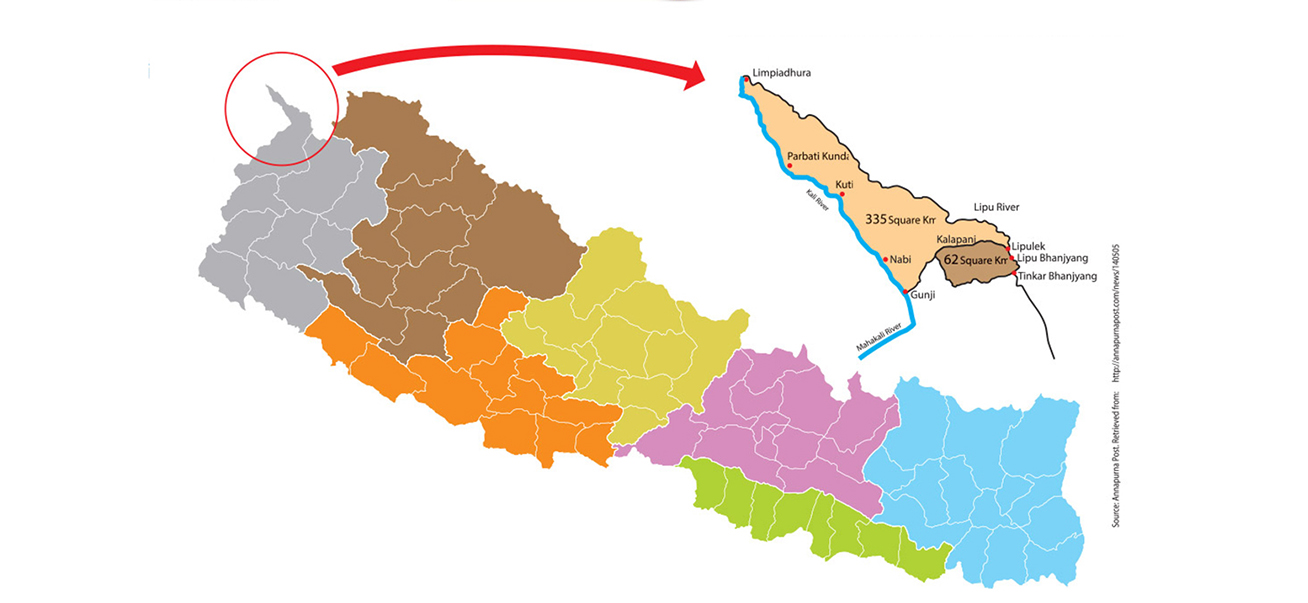
“Between Nepal and India, there is a dispute over an area of more than 154 square kilometers. Among them, the most contentious and complex region is the Susta and Kalapani area.
After the Gandak Treaty, when the Narayani River changed its course, India encroached upon an area of 19,980 hectares. Similarly, in the Kalapani region, only 335 square kilometers of Nepalese territory has been encroached upon.
The Nepalese government has published updated maps after including the Kalapani, Lipulekh and Limpiyadhura areas which has created tensions between Nepal and India.

Indian media and analysts often blame Nepal’s border dispute with India on Chinese influence and assert that Nepal raised the border issue as a response to China’s pressure. However many experts and border analysts have confirmed Nepal’s claim of encroached territories and dismissed the argument with multiple maps and evidence.
Minister for Land Management, Cooperative, and Poverty Alleviation, Padma Kumari Aryal, stated that the territories of Kalapani, Lipulekh, and Limpiyadhura belong to Nepal. She mentioned, ‘There is sufficient evidence that we have retaken the encroached land. We have completed 50% of the work through mapping. The remaining 50% will be accomplished by bringing back the land.’
The historical maps and documents, including the Sugauli Treaty of 1815 between Nepal and the British East India Company, confirm Nepal’s claim over the Kalapani, Lipulekh, and Limpiyadhura areas. Experts have also collected various proofs and evidence from different periods to support Nepal’s stance on the encroached territories.
Former director of the Department of Surveys, Punya Prasad Oli, stated that the Mahakali River was referred to as the Sharda River in the treaty signed in 1960 with the British East India Company, confirming Nepal’s claim. He also mentioned that other historical documents, including a map made by J.B. Tassin in 1817, show the inclusion of Kalapani, Lipulekh, and Limpiyadhura in Nepal.
In 1995, on 19 Asar, residents of Nabi, Kuti, and Gunji submitted a letter to the British Residency in Kathmandu, stating their desire to remain in Nepal. The letter is safely preserved in the National Archives.
In 2015, the residents of the same region actively participated in the elections. The voter list of Nabi, Kuti, and Gunji is also stored in the Election Commission. In the 2018 census, the senior enumerator Bhairav Rishal revealed that the population of the area was around 1400 to 2000 people, even though he had missed counting some households.
After 2018, there is no information available to the Nepalese government regarding the population in that area.”







Discussion about this post