

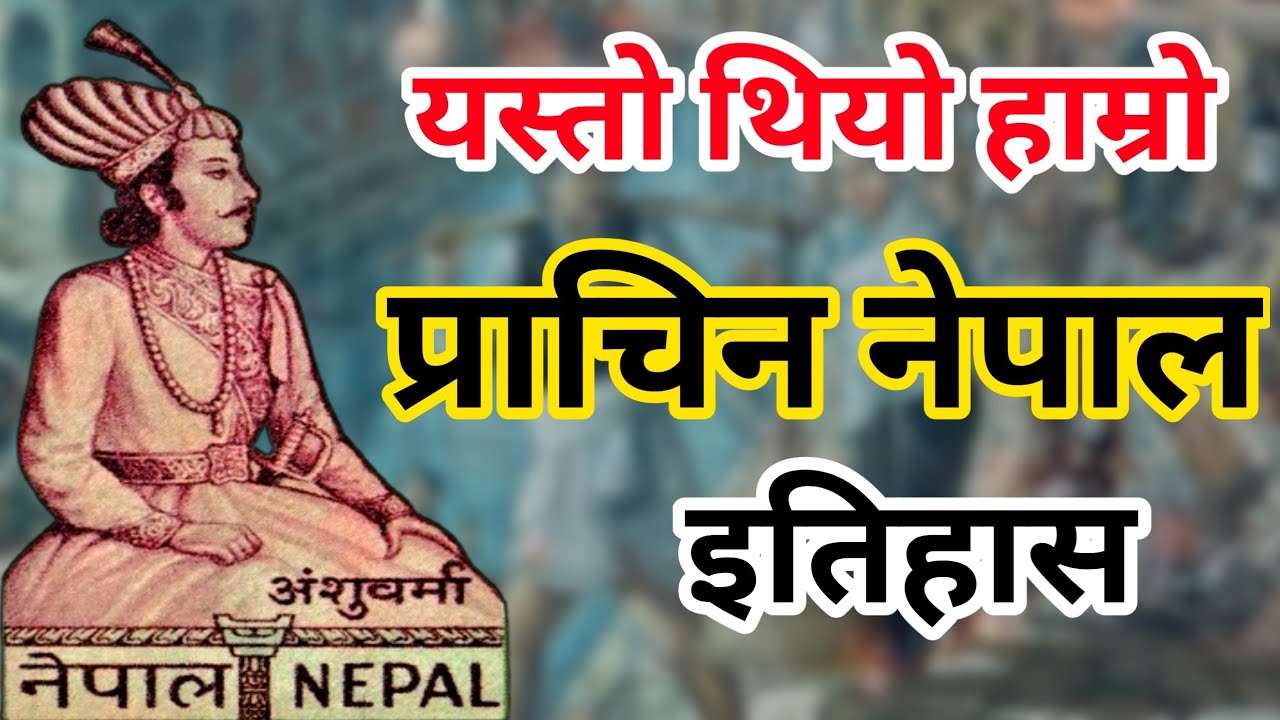
Nepal is a country with a glorious history. The history of Nepal is considered very ancient. Nepal was called Satyavati in Satya Yuga, Tapovan in Treta Yuga and Muktisopan in Dwapara Yuga. It can be assumed that the history of Nepal is very ancient because the name Nepal is mentioned in various texts of the Puranic period. The remains of Ramapithecus human found in Butwal region of western Nepal confirm the fact that human habitation started in Nepal more than 10 million years ago.
Nepal was the hotbed of various sages. Hundreds of sages like Kaushik, Balmiki and others used to do penance here. Ascetics like Vipaswi Buddha, Shikhi Buddha, Vishwabhu Buddha, Manjushri Bodhisattva, Vrakuchhand Buddha used to come here from time to time. The history of Nepal is mainly studied by dividing it into three sections namely ancient period, middle period and modern period. Kaal means a period of time.
Before the unification by Prithvi Narayan Shah, Nepal was understood as the state that developed in the Kathmandu Valley. That kingdom kept expanding and breaking up from time to time. King Prithvi Narayan Shah of Gorkha He conquered Kathmandu in 1825. After that, he established the modern state of Nepal by making Kathmandu the capital. This glorious country is today’s Nepal.

Period division of Nepal’s history
| ancient time | V.No. Before 936 | Before Nepal Samvat begins |
|
Middle period |
V.No. 936 to 1825 |
Since the beginning of Nepal Samvat, Nepal is in the process of unification
till the conquest of Kantipur by Prithvi Narayan Shah |
| Modern period | V.No. From 1825 to the present | From Prithvi Narayan Shah’s conquest of Kathmandu till now |
1. The origin of the state of Nepal
Historians have searched for various evidences and brought out the facts about how the state of Nepal came to be. Based on this, one can guess how the origin and naming of Nepal happened. Various facts and opinions about the origin and naming of the state of Nepal have come to light.
(a) Geographical Facts
About 130 million years ago, there was a sea called Tethys Sagar where Nepal is located. As the land to the south moved towards the north, the back of the Tethys Sea was torn apart and rising above the back land. The materials brought by the surrounding rivers were also piling up. This is how the Himalayas and the Moddar mountains came into being. Present day Nepal lies in the middle of that Moddar mountain. This fact is also confirmed by the fact that limestone and other limestone rocks are found in most places of Nepal. Limestone is formed by the accumulation of bones of sea creatures in the sea for millions of years. Marine fossils are also found in the Himalayan region of Nepal. Shaligram is also a fossil of marine life.
The river Kali Gandaki brings Shaligram from the Himalayan region. During the formation of mountains, a huge lake was formed in the place where Kathmandu valley is now. For millions of years, the surrounding rivers such as Bagmati, Bishnumati, Hanumante, Manhara, Godavari, Kodku, Nakkhu, etc., accumulated the material brought to the bottom of the lake. Chovar hill is a hill made of limestone. Because the limestone reacts with the water, the limestone eroded and the lake water dried up. Then people came from the hills around here and started grazing their cattle. He started farming here. After that, a kingdom named Nepal was established there.
(b) Mythological facts
In various religious texts such as Mahabharata, Pashupati Purana, Buddhist texts etc., the kingdom of Nepal and its kings are mentioned. The first mention of the name Nepal is found in the Atharva Parishita composed in 500 to 600 BC. From these facts, it can be said that Nepal existed since the Puranic period. At that time, there was Nepal in the central region, Mithila kingdom in the east, Shakya kingdom in the west.
(c) Historical facts
The Indian Gupta emperor Samudragupta mentioned Nepal as a ‘neighboring state’ in his Allahabad records. Almost all subsequent sources have mentioned Nepal as an independent state. In the inscriptions of Nepal, The word Nepal is mentioned for the first time in the Tistung records of 569. Thus, it is clear that this country has been known as Nepal since ancient times.
There are different arguments regarding how the name Nepal came to be. Historians have argued that the name Nepal came to be based on various facts.
(a) On the basis of language,
‘Nepal’ is the cultural form of the mythological Kirati word ‘Nepa’. In Kirati and Newari languages, ‘ne’ means ‘middle’ and ‘pa’ means ‘country’ ie ‘middle country’. It seems that the name Nepal comes from the suffix ‘L’ in ‘Nepa’ in the mid-hill section. In Tibetan language, ‘Ne’ means house and ‘Pal’ means home. At that time, as there was a lot of sheep breeding in this area,
he and he cloths were exported from Nepal to foreign countries. Therefore, it seems that the name of this area as the place where he will stay is Nepal. Nepal means flat land in Limbu language. It seems that the name Nepal has remained because it is a large plain valley in the mountainous section.
In the old Lepcha language, ‘ne’ means holy and ‘pal’ means cave. Thus, ‘Nepal’ refers to a holy place or a religious place. Therefore, according to the Lepcha language, the name of this place seems to have remained Nepal. The Tamangs of Nepal also call the shrine ‘Ne’. In the Lama scriptures, ‘ne’ means holy place. As there are many religious places in Nepal, according to the Tamang language, the name Nepal may have remained as a virtue. Neep in Sanskrit language means the foot of the mountain and it is assumed that Nepal is by adding the prefix aal (place) to the word. Aal means home. Since it is a valley in the lap of the mountains, it was called Nepal.
(b) According to legend,
a sage named ‘Ne’ lived in Nepal Valley according to Nepal Mahatma. Besides establishing this state, he also took care of the people here. Therefore, it is believed that the name of this country remained Nepal because it was ruled by Ne Muni.
(c) Historical basis
The ancient rulers of Nepal were called “Nip”. Alay means home. Therefore, this country was called Nepal because it was a state ruled by the Nips.
3. Ancient Nepal
Although the ancient history of Nepalese civilization is largely based on legends, some fundamental things have been proven. Concrete historical materials from before the Kirat period have not been found. Especially the main sources of history of that time are Gopal genealogy, Bhasha genealogy, Kirkpatrick’s genealogy and Wright genealogy. In addition to this, Hindu and Buddhist religious texts and records and statues of the Lichchha period are also considered as the basis.
Similarly, Kautilya’s Arthashastra and Chinese traveler Hu Ensang’s travelogue also mention the facts of Nepal’s Lichchavian history. Some glimpses of the political, economic, social conditions, etc. of this period can be found from the records of the Lichcha period. Although the Lichchha period began with the beginning of the Christian era, based on the evidence, the history of ancient Nepal has become more reliable only from the fifth century AD.
(a) Gopal dynasty
The first kings of Nepal were Gopal dynasty. Gopal means the cowherd community. After the water of the Kathmandu valley came out, this place became muddy and full of vegetation. Therefore, the ancient Naga tribes living in the surrounding hills came and settled in the valley. Seeing the fertile grassland here, the Neep caste cowherds from the south were attracted here. There was a conflict between the Nips (Gopals) who came from the south and the ancient Naga caste here.
The Nagjatis were defeated and moved towards the south, while the Gopals dominated the Nepal Valley. A sage named ‘Ne’, who lived in Teku Dobhanmatpasya, made Bhuktaman (also known as Bhumigupta) of the Gopal dynasty the king. He is the founder of Gopal dynasty and the first king of Nepal. According to Gopa genealogy, eight rulers of Gopal dynasty ruled Nepal for about 505 years. In which Gopal dynasty rulers Bhumi Gupta, Jai Gupta, Dharma Gupta, Harsha Gupta, Bhima Gupta, Mani Gupta, Vishnu Gupta Rajin Gupta ruled.
(b) Mahishapal dynasty
As mentioned in the Gopal Dynasty, the Mahishapalas established control over the government of Nepal by defeating Jean Gupta of the Gopal dynasty in a war. Cow breeders were called Gopal and buffalo breeders were called Mahishpal or Abeer. They used to keep a large number of buffaloes in the flat land between Simraungadh Rajanpur and kept their weapons with them. The first king of this dynasty is Varasimha. According to Bhasha genealogy, the three rulers of this dynasty, Varvar Singh, Jai Singh and Bhuwan Singh, ruled for about 161 years.
(c) Kirat dynasty
Gopal genealogy lists Kirat kings as well as their place of origin is said to be the land between Tamakosi and Sunkosi. The last king of Abir dynasty, Bhuvansingh, was defeated in a war by Kirat dynasty Rajaylung or Yalambar. It is believed that 32 kings of 29 generations of the Kirat Dynasty ruled for about 1500 years. It is believed that the old name of the city of Patan, Yal Rahn, came from the name of Yalambar.
It is believed that the head of Akash Bhairava, which is placed on a pillar in Indra Jatra, belongs to this Yalambar. It is mentioned that Kirateswara Mahadev was born in his time and Kirateswara Mahadev fought with Arjuna, a great warrior of the Mahabharata war. During the reign of Jitedasti, the seventh Kirati king, Gautama Buddha’s disciple monk Ananda came to Nepal. During the reign of the fourteenth Kirati King Sthungko, the Mauryan Emperor Ashoka of India came to Nepal with his daughter Charumati.
The pillar he placed in Lumbini after discovering the birth place of Gautama Buddha is still standing. Even in Lalitpur, Emperor Ashoka had four stupas built in the four corners of the city. Those stupas can still be seen in Lagankhel, Pulchok and Imadol in Lalitpur. It is mentioned that his daughter Charumati built Chabahilma Vihar. A monastery built for Buddhist monks to live and study is also called Bahil.
It is believed that the name of the Vihar is Chabahil from the name of Charumati. Charumati was married to Devpal of Kantipur. A settlement was built there in his name which is known as Devpattan (Deupatan). Some of the settlements named during the Kirat period still exist. Bhaktapur is called Khop in Newari language. It was called Khopring during Kirat period. In the same way, during the Kirat period there were settlement names such as Teku from Tengkhu, Sanga from Sanga, Changu from Changu, Khurpasi from Khopasi, which are still in use.
At the end of Kirat rule, eight hundred Kirats were killed in a place called Chaisal in Lalitpur. Chas means eight hundred. That is why the name of that place has remained Chaisal. Although historical and archaeological evidences of Kirat period are not found, the statue of Virupaksha with broad chest in Pashupati is believed to belong to Kirat period. The last Kirati king was Gasti. Some historians have written that the last Kirati king was Khigu.
4. Economic and social situation
The economic and social situation of the Gopal, Mahishpal and Kirati regimes of ancient times is not so clear. However, based on the facts of that time, it can be mentioned as follows. Animal husbandry was the main economic activity of the Gopal dynasty. Since the Kathmandu valley is made of fertile clay soil, there was plenty of grass here. Therefore, the residents used to rear cows. Due to the terrain made of clay soil, agricultural business was also done here.
During the Mahishapal dynasty, buffaloes were reared. Other things were like the Gopal dynasty. During the Kirat period, people also did hunting along with agriculture and animal husbandry. In all the three periods, the necessary goods were prepared from the domestic industry. The society was based on Hindu religious traditions. From the origin of Pashupatinath and the construction of the temple, it can be assumed that Shaivism developed at that time. As Kirateswara Mahadev remained in Pashupati, it seems that Shaivism continued in the Kirat period as well. At that time, various festivals were celebrated according to Hindu traditions.




Discussion about this post